"He said I was unequipped to meet life because I had no sense of humor."

Wednesday, April 20, 2011

Von Deutschland!


Hello team!  I am writing from Krakow Poland, after a lovely three day stay in Berlin on the hospitality of Irina, who graciously offered us her Berlin apartment.  We saw some impressive cultural memoria, as well as the populous and architecture of the German capitol, and Corinne wasn't arrested on arrival!  In all, a satisfying trip.  Here are a few highlights.  

We arrived in Berlin on Wednesday April 13, me from Rome and C from Stockholm.  C, having arrived three hours before me, assumed control of Berlin and had our transportation and finances arranged for our three day stay in the city.  That first day was pretty slow, we stopped at a cafe on our way in, along with a grocery store with Michael, Irina's partner and our secondary host, and ate in and bedded early.  

The following day we undertook the post-war history of Berlin, which became our focus for our short stay.  We attempted the Dali museum, found it closed, and wandered over to the German history museum.  On the way we saw the Jewish memorial - a 'cemetery' of concrete blocks filling a city block in central Berlin.  It was a dreary rainy day, and C and I took in the gravity and power of the monument.  Here are a few photographs of the blocks, arranged in cemetery fashion to great effect.  

The block varied in height and the ground level changed, creating multiple perspectives and effects


The walk ways and some of the police force


An overview of sorts - the blocks in middle are 8 or 9 feet up from the walkways


An eye level view

After the memorial, we passed the Brandenburg along with a main drag of central Berlin, often crossing paths with police columns escorting tinted Audi's carrying the western world's diplomats to and from meetings of NATO, convening in Berlin to discuss Libya.  The constant stream of police, as well as the drone of helicopters, blocked roads and assumed proximity of Hilary Clinton made us feel very important indeed.  Amidst the excitement we visited the German history museum and saw the Rome and Europe through the eyes of the Vandal and Saxons (who just wanted to settle in Roman territory is all).  From the sound of it, the Germans were building cities and princedoms while the rest of Europe was killing each other or succumbing to the plague.  In my version of history lay a dark period from the fall of Rome in the 5th century to the Italian renaissance of the 14th century.  However, it seems like the Prussians were at this time leading the charge of civilization, building castles and centers of learning in and around the dark forests and mountains of eastern Europe. 

As we somewhat expected, Berlin was often colored by its postwar history (of course, we also toured these areas specifically).  The history museum had broad sections on pre and post war propaganda with exhibits demonstrating the nuance of the National Socialists rise to power (I for one had grossly oversimplified that process – many people warned about the extreme right and Hitler specifically) with special attention paid to the death camps.  I can only imagine how a curator might handle the construction and placement and wording of that diorama -  (poetry and art after the holocaust is barbaric, according to Theodor Adorno).  After enjoying the museum, we continued to skirt the diplomats of NATO while making our way back across the downtown area en route to the Dali museum (which was not really worth the price of admission). 

Our next bit of history was about the Berlin wall itself.  After the war Berlin was divided into four sections – British, French, US and Soviet.  We developed our half and played by the rules while the Soviets decided to keep everything for itself.  When the built the wall in 1961, Kennedy was (according to the history over here) somewhat relieved that war was less likely with the divide up, and that the US had little choice but to accept the reality of the Iron Curtain having fallen over eastern Europe.  Facts of this are likely obvious to people who were adults when this was all going on, but I did not know that Berlin was entirely surrounded by Soviet controlled Germany, a tiny enclave of capitalism.  The East Germans supposedly did not see or think of this barrier as a wall – but as an anti-capitalism blockade, working to keep the evils of capitalism out.  Of course, the purpose was to stop the mass migration of people from the Soviet east to the west (who were leaving at a rate of several hundred thousand per year).  The wall divided the city in half, along roads, rivers, and even buildings.  There is upsetting footage of people running across barbed wire barriers (before the concrete wall), or jumping out of buildings that faced the west.  It was powerful and visually stunning to see the footage next to the wall itself – such a recent history buried beneath the surface of my reality.  It, along with a visit to a Stasi secret prison gave me a new appreciation for (though not changing my mind about) McCarthyism.  Here are some photos of the wall memorial: 

Comssioned art on the East wall - done 90 and 91


These images are mostly based on famous photos - (http://www.spiegel.de/international/germany/0,1518,615900,00.html ,  http://in-humanity.net/tag/east-german-soldier/ )


The following day C and I visited the secret prison of the Stasi (after the Soviets changed it from a soup kitchen into a secret prison – only the Soviets could use Communism to change a soup kitchen into a prison).  The tours (in Polish) were given by former inmates – our tour being in English was given by an historian.  The prison structure was simple enough – prison like, what was notable was the evolution of the function from torture to solitary confinement.  The Soviets initially used several forms of water torture (drips, a few inches of freezing water on the ground) sleep deprivation and packing people into tiny windowless basement rooms called U-Boats by the prisoners (who were exclusively political prisoners).  Later the prison used solitary confinement only to torture the inmates.  They went so far as to not allow prisoners to pass each other in the hallway.  It was a depressing, difficult tour.  C took a few photos inside of the submarine, though I do not have them with me.  I'm sure you can appreciate what it felt like to stand down there for even a minute - a cell with no moving air and twelve people.  Yikes.  

We were then on our way out of Germany and into Poland, where we have enjoyed the beautiful city of Krakow for the past few days.  Incidentally, due to a train station mishap, we are here for one more day – not the worst place to be around for a little more time.  Before we left we saw lots of Berlin, enjoyed several delightful meals (we looked often for German food but found mostly SE Asian fare – Thai, Korean, Tibetan, Vietnamese).  We a great brunch with Irina and Michael at a cafĂ© they selected for us (whose name escapes me).  I took a photo of our food (along with a few of the city). 


Note the giant sculpture in the background


A beautiful rail bridge!


It was lovely weather, and a lovely city!
One final travel story on this entry – on our train from Berlin to Krakow, a fellow sitting in front of us managed to snooze his way out of Germany with a ticket meant to get him to Dresden in southern Germany.  The German ticket check had stamped his ticket without comment, but the Polish conductor was paying more attention and forced him off at the next station (in rural Poland).  He spoke Italian, and miraculously the woman across the aisle from him spoke Polish and Italian.  Corinne and I watched the exchange, the conductor telling him to get off, not swayed by the confusion with the first stamp or anything else the woman said to him.  As the Italian (maybe 19 years old) got off the train the woman who had advocated for him gave him a 50 euro note (almost 80$).  It was a powerful little episode about being cared for by strangers, and made me more resolved than ever to pick up fluency in another language (or two).  Thanks for reading! 


Tuesday, April 12, 2011

Rome part due

Rome has once again captured my heart, though it is of course a different  experience, both being joined by my mom and staying in the city itself, rather than at the home of Paolo and Alessandra.  We are at a converted convent within a 5 minute walk of St Peter’s Square.  It is a nice landmark to come ‘home’ to after wandering the town, we are generally making our way north along the Tiber river

Our second night in Rome was spent on lovely Aventine Hill, once again in the company of William.  I mentioned a few of the sights he shared with me but I’d like to clarify and flesh a few out.  The church of St Dominic, where he would lay prostrate to pray, where time passed in centuries rather than seconds, the church where we stood had been built in the 5th century, which meant that when St Dominic (founder of the Dominicans) prayed there it was already 700 years old.  I took some photos, though they are on my Mom’s camera.  William also showed us a keyhole through which one could see the temple of the Knights of Malta, the Vatican dome, and of course Rome, which comprise three individual countries among them.  William called it the most famous keyhole in Rome. 

In the middle of our time here we visited the Villa Borghese, the house and now museum collected by the Pope’s nephew.  It most impressively contained several sculptures by Bernini, an absolute master of the form.  His pieces had a liveliness and movement to them, along with delicate features and craftsmanship.  His most impressive to me was his statue of Apollo and Daphne.  The story is that Apollo was chasing the less than willing Daphne, who prayed to her father the river god to save her from Apollo’s amorous clutches.  As Apollo catches her, she is turned into a laurel tree.  Bernini shows this in action, you can almost hear her limbs creaking into wooden branches, her toes plunging into the ground as roots.  Her outstretched fingers sprout twigs and leaves.  Apollo is just behind her, his cloak billowing behind him, his back leg suspended in the air.  The sculpture looks like a 3D photograph or a wax model, rather than carved marble.  His other pieces in the museum, his David, his god of the underworld carting off his captured bride, all had the same life like quality to them.  Check out some images here.  

We spent our last morning in Rome touring the obscene opulence of the Vatican Museum.  It at once housed great works of renaissance art and an overlarge collection of Greco-roman antiquities, seemingly collected for numbers alone.  To catalogue the latter, there were dozens of rooms and hallways filled, stacked with busts, statues and friezes depicting god knows what from ancient Rome.  I overheard a tour guide saying that to give each statue one minute would require a visit of 25 years.  While the Borghese museum had a few dozen statues, among them great works of Bernini mastery, the Vatican housed anonymous faces and scenes, uncurated and unapproachable. 

However, it also had rooms painted by two of the ninja turtles - Raphael and Michelangelo, including the Sistine chapel which was worth every accolade.  I’ll lodge one more complaint about the nature of the work they were commissioned to create, then admire the works themselves.  It seemed like every painting (indeed every facet of the Vatican that I noticed) seemed directed at salving a great ego crisis suffered by Pope after Pope after Pope – every one in his turn trying to establish his legitimacy in the history of the Bible and of the world.  The Sistine chapel is ceilinged by Michelangelo’s famous creation of Adam (and his less celebrated fall from innocence), but two of the walls contain mirroring scenes from the lives of Moses and Jesus, establishing Jesus in the Mosaic tradition of punishing disbelievers and wayward skeptics.  They seemed to say – I am the Pope, and if you don’t like it you can join that guy suffering in hell.  Raphael’s work in the Papal apartments included the ‘School of Athens’ where the Greek scholars resembled renaissance artists and holy folks, saying that even back then Christianity was just around the corner. 

Of course, the works themselves were beautiful.  Michaelangelo’s chapel was a masterpiece for its assimilation of so many images and themes, like a visual history of everything.  He painted the ceiling at 25, and the altar wall at the other end of his life at 66.  The altar wall depicts the last judgment and is a chaotic swirl or salvation and damnation.  All the familiar faces are present in one form of another, including one guy holding his own skin (having been flayed alive).  Yikes.  

Unfortunately for me (and indirectly you), the Vatican museum confirmed my deep skepticism of the Catholic church’s commitment to social justice, now and throughout history.  I’ve seen some opulent palaces in my day, and have done my share of inward head shaking at this or that king or queen who decided themselves worthy of everyone else’s livelihood (or life), but they never pretended to give a rat’s ass about the poor.  The Vatican library apparently housed one of the world’s greatest collection of literature and history – preserving for us texts and ideas that lend themselves to the foundation of our civilization, but that’s where it ends for me.  The Vatican is not directly responsible for the poverty of the world (though I think a case might be made), but it’s wealth could go a long way towards alleviating it.  “Until you give up everything you have, you cannot be my disciple.”  JC

When we weren’t touring the Coliseum, a famous museum or a church somewhere, we were wandering around  or eating or in transition from one to the other.  The city treated us well – our weather has been unreasonably lovely, sunny every day but one and no rain, and our walks have always been fruitful in one form or another.  It has been very different traveling in the comfort of Italy, particularly with my mother with me, and is serving as a lovely transition back to home for me after my time in the Arab states and India.  Tomorrow morning Mom heads back to the US, and I am off to Berlin where I will meet lovely Corinne.  I am eager to see her, eager to tour the north of Europe, and eager to head home, though the feeling is bittersweet.  I have reconciled many of the tensions I have encountered on my travels, and am at present much more adjusted to the road than to being in one spot.  Most likely the transition will be plenty smooth, and I’ll be feeling restless again in no time.  But for now, German here I come!  Thanks for reading!  

PS - here are some general images from the Coliseum and Vatican Museum:


Entrance to the Vatican Museum


Raphael's 'The School of Athens'

The famous exit
  

Saturday, April 9, 2011

Firenze!


First off my apologies for being so behind in posts – Florence was marvelous and between enjoying the city and enjoying the company of Mother, I had very little down time during which to write.  We are now already back in Rome – having spent time in Florence and Cinque Terre!  I will do my best to bring some reflection to bear on those places, seen in the light of my Mom’s new eyes as well as my personal experiences. 

Mom touched down in Rome a bit later than expected, having been delayed by weather in NY.  I found my way to the Roman airport later than expected because of a local transportation strike in the city that morning.  Paolo, my most gracious host, actually offered me his car for the cross city trip to the airport but I was able to catch the last bus of the morning to the Termini station for a quick jaunt out to the airport.  To touch off a dicey pick-up, the customs exit dropped Mom at a different terminal, so we spent the better part of an hour looking for each other – I being worried that her checked bags did not make it off the plane because of ANOTHER strike.  She wisely did not check bags, found me, and we were on our merry way into town. 

It was a joyful and somewhat teary reunion for both of us – she talked often about how big of a deal my journey was, of how her friends all shared her excitement to get her hands on me.  For my part it was a first real feeling of being home after my seven month trek.  Spending time with Corinne has always grounded me, but seeing one’s mother after being away is something special and I appreciated all the more her trip overseas.  We shared many hugs before she conked out on the train.
 
View from our window!

Our place in Florence, after we got in the door, was pretty great – we staying at San Giovanni hotel on the Duomo piazza – we could see the Cathedral from our window.  Florence is mostly known as a city of renaissance art, and we wasted no time visiting the Ufuzzi and the Academie the next day.  While we didn’t quite distinguish all of our Littis from our Giottos, we saw an amazing arc of western art culminating in Titians and Michaelangelos that were truly breathtaking. 

There he is!

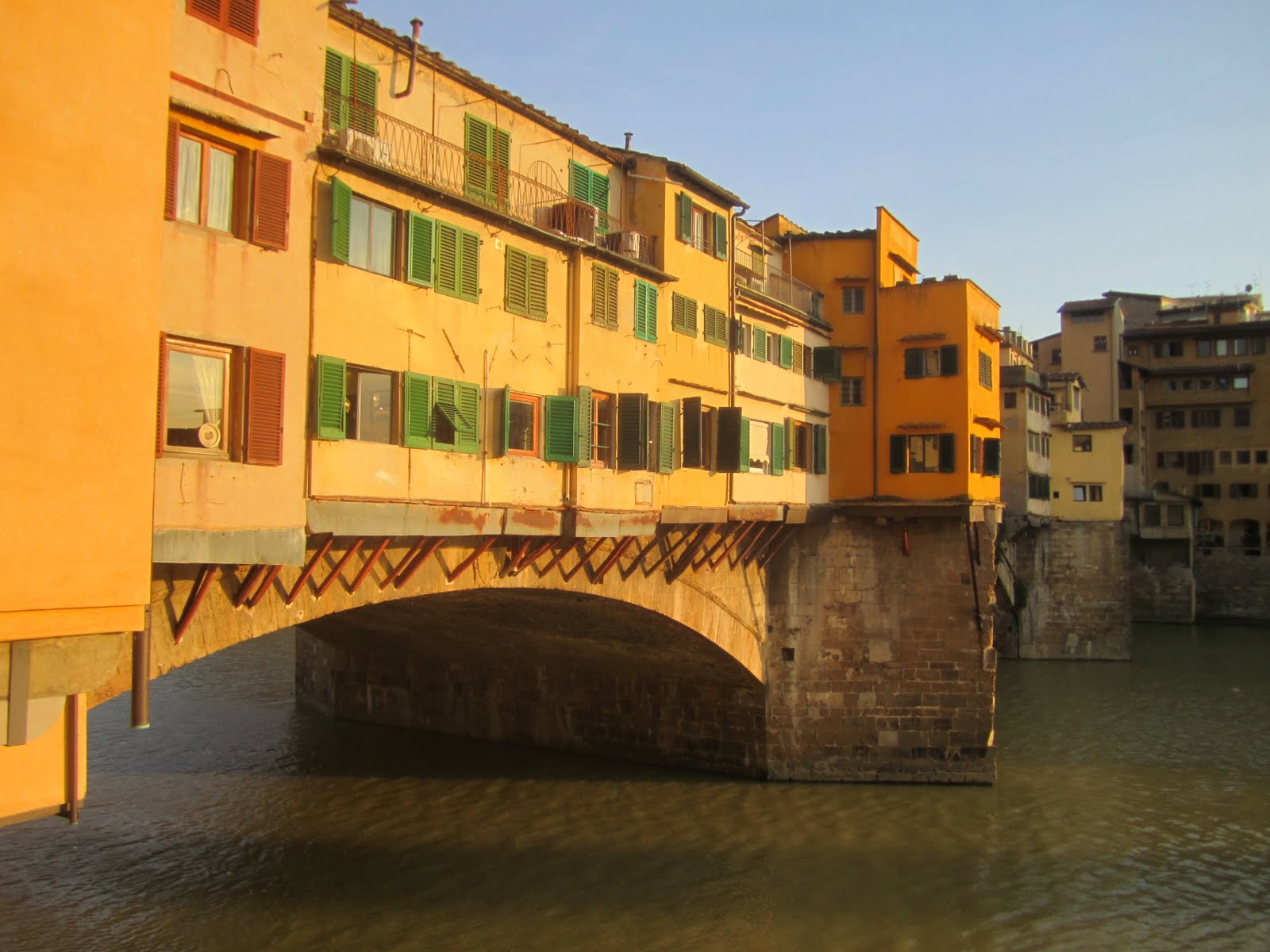
The other notable mark of Florence is its picturesque cityscape.  We spent many hours wandering (sometimes lost) around the north and south bank of the Arno river, enjoying the Florentine architecture, Florentines and of course the ubiquitous tourist.  We stopped into a number of churches – some of them housing the final resting place of the renaissance artists like Galileo and Michaelangelo.  We found a number of lovely dinner spots and enjoyed our fair share of Tuscan fare and wine.  Florence was pretty magical for me – a smaller version of Rome which condensed both the sights and the tourists.  Here are a few images from our various haunts around the city.


St Anthony?  Did we find St Anthony?  


Michaelangelo's tomb - with the muses of painting, sculpture and architechture


We also, at the recommendation of Mom’s former student, visited the nearby town of Siena, home of her patron Saint Catherine, whose head was on display (along with a thumb) at the church of St Dominic’s in Siena.  There is a dimension of iconography that deepened my already profound confusion at the intricacies of Catholic doctrine.  I had some difficulty experiencing anything other than that confusion as we witnessed this 13th century head preserved and on display on an altar.  Siena was a nice little day trip for us, a comfy train ride, a comfy city, and a lovely lunch with a German couple.  We ate on a hillside cafĂ© on propped tables, across the street from 17th century address plates marked in Roman numerals.  A final note of interest in Siena – the town’s colors seemed to be black and white, and the Duomo of Siena (which almost became the biggest church in the world) was layered black and white marble – and even in its ‘unfinished’ state was pretty massive for a town the size of Siena. 

80's Michael Keaton movie?  Anyone?

It was a big church

Surreptitious photo of Mom with her patron Saint

Floor panel - slaughter of the innocents

Leonardo's St John

14th century rose window

Siena!


Siena and Florence gave us great flavors of the Tuscan area (if its somewhat well traveled parts), and I was sad to leave them, even for the beauty of the Mediterranean coast and the villages of Cinque Terre (5 lands).  Cinque Terre is five villages perched on the hillside over the sea, all within a 4 hour walk, all almost entirely boxed by their surroundings for most of the year until the railway came through.  We spent most of our time wandering in Monterrossa and Riomaggiore (where we stayed in a furnished apartment).  Monterrosssa had a lovely beach where we enjoyed the spectacular weather (unusual for Italy at this time of year, 70s and sunny every day), and Mom even took a dip!  Cheers Mom!    

That will have to do it for this entry – we are as I mentioned back in Rome on the final leg of our journey together.  We enjoyed a lovely dinner with William last night and are looking forward to meeting Paolo and Alessandra for a meal in the next day or two.  Thanks for reading!  

Friday, April 1, 2011

Stories of Rome


So Rome – the Eternal City – Athens 2.0.  Anyway, I’m digging on it, and here’s why.  As you know, travels thus far have been adventurous and sometimes arduous.  India particularly tested my limits physically and, as a result, emotionally.  I often felt I was more or less alone trying to make my way without many of the comforts of the western world available.  Whine whine whine. 

Italy, on the other hand, is full of such conveniences – it rivaled Istanbul for restaurants and fun antique shops on every corner, along with quaint cobblestone streets in the center of a bustling metropolis.  Rome not only has layers of history (sometimes exposed for our consideration), but it also has many quiet pockets where a person could sit down and feel moments of quiet and comfort with the pulse of the city waiting just outside.  Maybe India set my appreciation to stun, but I think Rome might be a favorite city of mine, right there with Istanbul and Minneapolis / St Paul. 

I give much of the credit for these feelings of comfort to my hosts, Paolo and Alessandra Morelli, the parents of Corinne’s classmate Giulia.  They, without having met me, knowing me only as their daughter’s friend’s BOYfriend, agreed to not only take me in, but to give me keys to their house so I could let myself in because they were out of town!  Incidentally they were visiting Giulia in Stockholm, so we did have a chance to meet and introduce ourselves.  We talked over various routes from the bus stop to their house and a few brief plans for when they would be in town with me, and that was that – they passed over the keys and I was on my way. 

Incidentally I still have the keys and here’s why.  I’m writing this on the morning of April first, sitting at the airport, waiting for my mother to touch town from Frankfurt.  I am ironically early because the Roman transportation is on strike today – buses stopped running at 9, and the metro is shut down.  Trains are sporadic but running.  When we found this out, Paolo not only called the city (whose recording told him he could check the train schedule by looking at the display at the station – very helpful), but offered me his car to pick up Mom at the airport!  That is hospitality. 

So I have been well hosted – my first night in Rome was spent on a car tour of the outer sights of Rome with Carla and Giovanna, who in addition to hills and concert halls and stadiums showed me several lovely views of the city, including the view with the locks – pictured below.  I enjoyed a ‘typical Italian meal’ of (course one) sheep cheese, sausage, bread oil chips nuts and sparkling white win, (course two) pasta with red sauce and ham with a red wine and (course three) fruit and homemade lemon liquor.  Hot damn. 

The next morning I took the number 60 bus into the center of Rome, which is a beautiful as it is walkable.  I mostly wandered around, saw the outside of sites like the colleseum, art museums and the insides of a dozen churches (including St Peter’s), piazzas, the Pantheon and several other wonderful sites.  Everything was exciting – the shops with pizzas and paninis, squares with fountains in from of churches, each street sided by the dusty pastels of Roman apartments and offices.  When I got tired I could sit in a church (never more than a block away) – and sitting in a church was a great way to spend time!  These buildings were built primarily between 16 and 1700 and are ornately decorated.  I’m currently overhearing southern American English being employed to complain about the broken TVs on an airplane. 

ANYWAY – the next day and the day after were somewhat similar, exploring the Roman neighborhoods and finding  cafes, churches, and piazzas that I hope to show my mother when she and I are back here.  It has been particularly fun to explore knowing that I am plotting routes and sites to see again in only a few days; when I can share them with my mom who will be in Europe for the first time!  How exciting! 

A few highlights – Giulia’s cousin Adele offered to show me the ‘Protestant Cemetery’ in the south of Rome that houses several lovely tombs, most notably that of Keats (a favorite poet of hers – she is 18, I had to brush up on mine).  She also showed me the Angel of Grief and several others (pictured below).  The afternoon I met her, it rained and hailed for about 15 minutes, exactly the amount of time it took us to bus from the main Piazza Venezia to the cemetery.  We enjoyd the cemetery in the afternoon sun while the rain tapered off, everything clear and cool after the storm.  It was perhaps the best way to visit a cemetery with someone who knows a thing or two about it. 

After the cemetery visit I made my way up the nearby Aventino Hill to visit Fr William Skudlarek, a monk from St John’s who had known my parents a million years ago.  He had agreed to host me for dinner and show me around the famous Sant Anselmo’s monastery.  I met him a early, around five, which gave us plenty fo time to explore the neighborhood where he showed me the most famous keyhole in the world which showed Rome, St Peter’s dome, and one other church that was its own country – three territories through a keyhole.  We also saw Palatine Hill which is the south end of the Forum and was Nero’s palace, who continued on the wrong side of history (when he saw his palace he said ‘Now I can live like a man,’ classy).  We also saw the Dominican Basilica, twelfth century, where St Dominican himself lived and prayed.  It had a gravity of age that reminded me of the Pantheon.  The space was incredibly ‘there’ – unalterably so.  It felt like an airy indoor tomb, that if I sat down without paying attention I would soon be a pile of dust.  Then, in a contemporary turn, we attended Latin vespers and dinner in the refectory.  Outside of vespers and our moment in the basilica, William and I enjoyed ongoing conversation on a wide range of topics (politics, art, society, language, place, travel) – it was one of the first times I had participated in such an extended conversation since leaving home and I drank in every moment.  Again, I had the luxury of knowing that I would be back with my mother in a few days – to see again the sights of Aventine hill and enjoy William’s company. 

My host Paolo’s English was pretty strong, so he and I also shared some lovely conversation.  We talked about art quite a bit, and of one of his favorite artists, Carevaggio.  Carevaggio has several works in a few churches in Rome – you simply walk in and follow the crowds to see the master’s work with color and light.   I found several of the churches he mentioned and made note of a few other spots to try to see when I am back in a few days.  Paolo and Alessandra both grew up in Rome and know and love the city.  In the comfort of their hospitality I thought often of the Twin Cities and how I might extend that gift to someone else.  Of course, we do not enjoy the tourism of Rome (nor the sights or abundance of tasty Italian food), but we certainly have a lot to offer.  My hosts have all taught my things about hospitality, what it means to share it and how incredibly powerful it is to receive it.  My love for Rome comes from how welcomed and loved I have felt since arriving.  I hope I can create the same feeling for my mom. 

By the time I post this we will be ensconced in Florence, and I will already be behind on sharing stories and photos.  I remain excited to come home (in about a month!), but this trip and my next journey with Corinne across northern Europe will be high notes on which to end, like that one perfect hole in golf that keeps my Dad coming back to the game.  Thanks for reading!  

The Eternal City

Hey team! I am writing from the elegant comforts of the Eternal City, where I have enjoyed the overwhelming hospitality of the Marinello-Touzzi's, Giulia's family in Rome. Giulia is in Corinne's program at KTH and kindly offered her family's hospitality when I was chatting with her about the sights to see in Italy and Rome.  I have been enjoying their hospitality immensely, along with that of a St John's connection, Fr William Skudlarek, who lives and works at San Anselmo's Abbey in Rome.

It is late, midnight, my mother arrives in 8 hours from New York, so this entry will be brief.  I'm sorry I have not accounted for my time more generously, but it has been a time of plenty for me.  I am well hosted, well traveled and well fed.  Here are a few snapshots:


A typical apt house in Giulia's neighborhood

A 'Romantic' story about lovers who locked their love on a bridge inspired many others - I was shown this by Giulia's aunts Carla and Giovanna

An old street near the ancient Foro

Buildings around P. Navoro

The Pantehon!  Its age leaps out at you

Inside the pantheon

St Peter's

A piazza

The Angel of Grief

Keat's grave - I was shown the cemetery by Giulia's cousin, a high schooler who studied Keats, Shelley, etc

Another house in Giulia's neighborhood

A street! (via, or corso)

One of dozens of churches
There are many more stories that will have to wait.  Tomorrow morning I pick up Mom at the airport and we head to Florence.  I hope to flesh out these images then.  Thanks for reading!